
The People: Groups, Ethnicity, and Language
- Supriti Parajuli
- Nov 26, 2020
- 4 min read
Updated: Aug 11, 2021
Comparing the size of Nepal to other countries, it's quite small. You can really see the size difference if you realize that it's stuck in between the two gigantic countries, India and China. Despite that, Nepal has been able to stay independent and maintain its culture for hundreds of thousands of years.
Let's talk about the people for a second, how many groups or ethnicities are there to be exact? A lot. For a country that has an area of only 147,181 km² (56,956 mi²), it is packed with diversity from all angles.
If I list all 100+ ethnic groups, we'll be here all day. I will list the most well-known groups here, as many as I can fit. If you would like to read more about other minority groups, I will link some articles towards the end of the post.
Kshetri/Chhetri: Speakers of the Khasa community some of whom trace their origins back to medieval India. They were a caste of administrators, governor and military elites during the medieval Khas Kingdom and Gorkha Kingdom. Most of the nobility of the Gorkha Kingdom, and later the majority of the Prime Ministers classify as Chhetri. They are the largest ethnic group in Nepal.
Brahmin-Hill/Bahun: A caste among the Khasa people, who trace their origins back to Indo-Aryans. They served with the Chhetri community back in the day, but due to the possible political power of the Khasa Malla kingdom, Khas Bahun and Khas Rajput (Chhetris) had high social statuses and Khas Bahuns are regarded as "twice-born" Hindus. They are the 2nd largest group in Nepal.
Magar: Their settlement covers the western and southern edges of Dhaulagiri Himalayan range and the eastern region of the Gandaki River basin. Most Magar people are Hindus and Buddhists. They have their own languages and customs/traditions.
Tharu: The origin of the Tharu people is not clear but surrounded by myths and oral tradition. The Rana Tharus claim to be of Rajput origin and to have migrated from the Thar Desert to Nepal's Far Western Tarai region. They are famous for their ability to survive in the malarial parts of the Tarai that were deadly to outsiders. They live in the Tarai region of Southern Nepal and are the largest group of that area.
Newar: They are the first inhabitants of the Kathmandu Valley, having created most of the heritage and civilization at the time. The Newari people form a linguistic and cultural community which primarily originate to Indo-Aryan and Tibeto-Burman ethnicities following Hinduism and Buddhism, and speaking Newari as their common language (which is really difficult to learn, in my opinion). Today, they consistently rank as the most economically, politically and socially advanced community of Nepal, according to the annual Human Development Index published by UNDP.
Tamang: They are descended from the Mongols, and are also found in significant numbers in Indian state of Sikkim and districts of Darjeeling and Kalimpong in India and in Bhutan. Tamang villages are often visited on Nepal's numerous trekking routes, one being labelled Tamang Heritage Trail. The Tamang language is the 5th most spoken language in Nepal.
Kami: An Indo-Aryan Nepali speaking group, the Kami were a Khas occupational caste of blacksmiths. They are also called Vishwokarma or Vishwokarmabramin. They live in the hilly or mountainous districts of Nepal and in the Indian areas of Assam, Sikkim and Darjeeling.
Musalman/Nepali Muslims: People residing in Nepal that follow the religion of Islam. Their ancestors arrived in Nepal from different parts of South Asia, Central Asia and Tibet during different epochs, and have since lived amidst the numerically dominant Hindus and Buddhists. Most of the Muslim community live in the Tarai region, while others are found mainly in the city of Kathmandu and Gorkha and the western hills.
Rai: Descendants of the Kirat Kingdom, they mainly live in the Indian states of Sikkim and West Bengal (predominantly the Darjeeling Hills) and Bhutan. The original name of Rai is Khambu. Rai means "King".
Gurung: One of the main Gurkha tribes, they are densely populated in Manang, Mustang, Kaski, Lamjung, Gorkha, Parbat and Syangja district. They celebrate their feasts and festivals, carry out ceremonies and practices related to worship, birth, death and marriage in accordance with the Bon and Buddhist religion. Losar is the main festival of the Gurung people, and is observed according to the ancient calendar of western Tibet. They also have their own unique language.
Damai: An occupational caste found among Khas people, people belonging to this caste are traditionally tailors and musicians. The Damai people are categorized under "Hill Dalit" among the 9 broad social groups, along with Kami, Badi, Sarki and Gaine by the Government of Nepal.
Limbu: Native to the Himalayan Limbuwan region of Eastern Nepal, Northern Sikkim, Kalimpong India, and Western Bhutan, the Limbu people have their own unique history. Although Limbuwan is now a part of Nepal, it was independent until 1774 AD. Even now, the history of Limbuwan remains unknown to many people.
Sherpas: One of the Tibetan ethnic groups native to the most mountainous regions of Nepal and the Himalayas, the Sherpas were mainly nomadic people. Many Sherpa are highly regarded as elite mountaineers and experts in their local area. They were immeasurably valuable to early explorers of the Himalayan region, serving as guides at the extreme altitudes of the peaks and passes in the region, particularly for expeditions to climb Mount Everest. Today, the term is often used by foreigners to refer to almost any guide or climbing supporter hired for mountaineering expeditions in the Himalayas, regardless of their ethnicity.
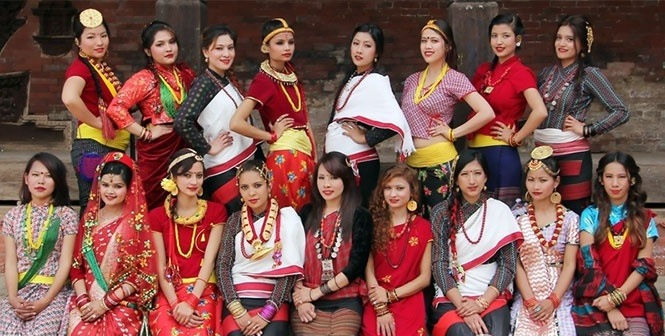
A visual representation of Nepali women from all different backgrounds/ethnic groups
*This image does not belong to me*
This map *which does not belong to me* gives a somewhat general idea of how diverse Nepal is:

If you would like to read a short report on the major and minor ethnic groups, check this out:
Here are some other links:


Comments